
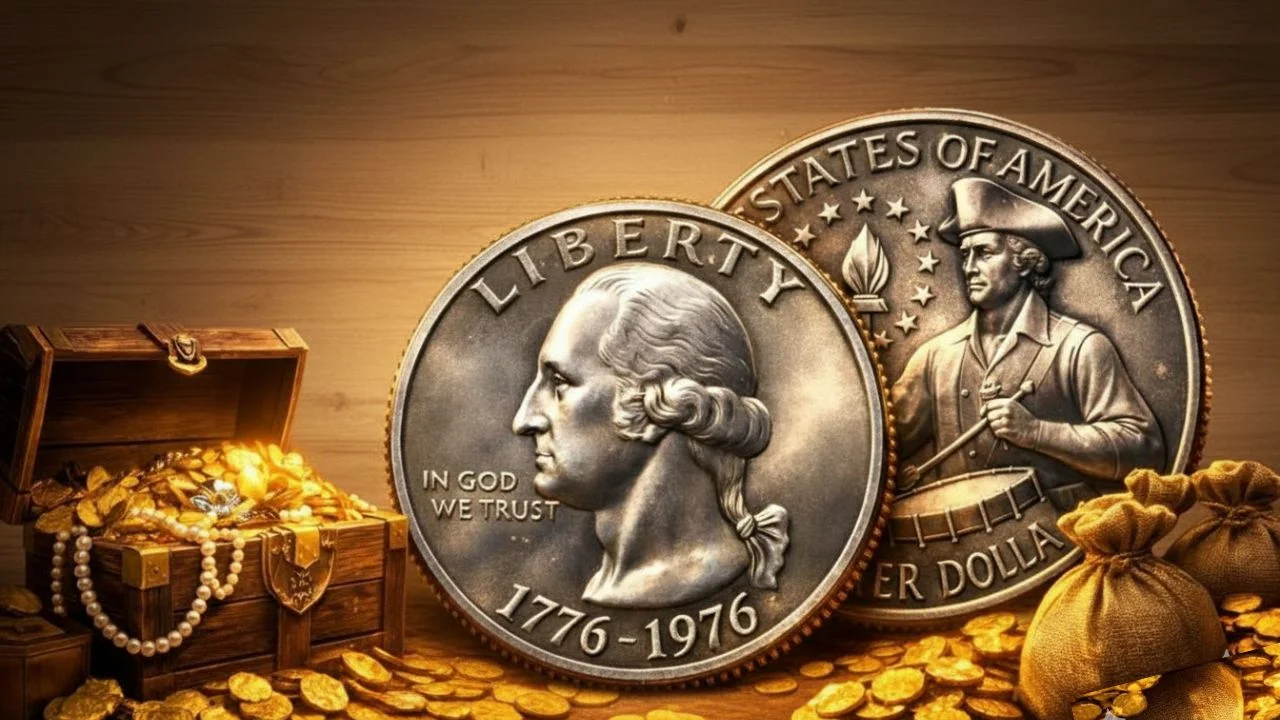
The 1776–1976 Bicentennial quarter, issued to celebrate the U.S. 200th anniversary, remains one of the most collected modern U.S. coins. While billions were minted across Philadelphia, Denver, and San Francisco, certain error varieties, silver-clad proof editions, and high-grade examples have surged in value, with some rare pieces reaching five and six figures at auction. In 2026, collector interest stays strong, fueled by registry sets, online auctions, and renewed focus on modern U.S. errors. This value guide covers the rare Bicentennial quarters that command big money in 2026, explains the most sought-after error coins and silver editions, current market trends, and how everyday examples compare to true rarities.
Brief History of the Bicentennial Quarter
The U.S. Mint released the Bicentennial quarter in 1975–1976 with a dual-date “1776–1976” obverse and a reverse featuring a colonial drummer boy designed by Jack L. Ahr. Coins were struck in copper-nickel clad for circulation and in 40% silver for special proof and uncirculated sets. Most circulation strikes (over 1.8 billion) are common and worth face value or modest premiums in high grade. The coins that reach extraordinary prices are dramatic errors, low-mintage silver proofs, or transitional pieces with unique characteristics.
Factors Driving Bicentennial Quarter Values in 2026
Condition (graded by PCGS or NGC) is critical—MS-67+ or PR-69+ examples of rare varieties command huge premiums. Rarity stems from low survival, dramatic errors, or limited silver distribution. Market demand in 2026 remains robust, with online auctions, registry competition, and interest in modern errors pushing prices higher.
- Error rarity: Coins with fewer than 100–200 known examples in high grade lead the market.
- Silver content: 40% silver proofs and uncirculated sets carry melt value plus numismatic premium.
- Certification: PCGS/NGC slabs add authenticity and boost resale value significantly.
Top Rare Bicentennial Quarters & 2026 Values
Here are the standout rarities collectors hunt in 2026, with approximate values based on recent auction records:
| Variety / Issue | Rarity Level | Typical Value Range (2026) | Record High Sale |
|---|---|---|---|
| 1976-S Silver Proof (Deep Cameo) | Common in proof | $10 – $500+ | $1,000+ (special) |
| 1976-S Silver Uncirculated (high grade) | Scarce in MS-67+ | $50 – $1,000+ | $1,500+ |
| 1976 No S Proof (missing mint mark) | Very rare (fewer than 300 known) | $5,000 – $40,000+ | $40,000+ |
| 1976-D Doubled Die Obverse (strong DDR) | Rare doubled die | $500 – $5,000+ | $10,000+ |
| 1976-P Off-Metal (on dime planchet) | Extreme error | $10,000 – $100,000+ | $100,000+ |
| 1976-S Silver Clad Transitional Error | Ultra-rare (wrong composition) | $50,000 – $200,000+ | $200,000+ |
The 1976 No S Proof and major off-metal strikes lead the high-end market, with silver editions adding melt value (about $8–$12 melt in 2026) plus collector premium.
How Rare Bicentennial Quarters Reach High Values
Coins reach five- and six-figure prices through:
- Extreme rarity — Fewer than 100–300 known examples in high grade
- Dramatic errors — Missing mint mark, doubled dies, or wrong planchet that are visually striking
- High-grade certification — MS-67+ or PR-69+ slabs from PCGS/NGC
- Collector competition — Registry sets and auction bidding wars
- Silver content — 40% silver proofs/uncirculated add intrinsic value
The 1976 No S Proof, for example, exploded because only a handful were struck without the “S” mint mark, creating instant rarity.
Current Market Trends in 2026
Modern U.S. quarter errors and Bicentennial varieties stay hot in 2026. Online auctions (Heritage, GreatCollections) regularly feature five-figure sales for major errors. Registry set competition pushes high-grade silver proofs and uncirculated pieces higher, while circulated errors (doubled dies, minor off-metal) trade in the hundreds to low thousands. Demand is strong for certified coins with clear visuals and strong eye appeal.
How to Identify and Value Your Bicentennial Quarters
- Check the date (dual 1776–1976) and mint mark (P, D, or S).
- Look for missing “S” on proof coins (very rare).
- Examine the drummer boy for doubling or unusual detail.
- Check edges and weight for off-metal strikes (silver coins weigh more).
- Submit high-potential coins to PCGS or NGC for grading.
- Use auction archives (Heritage, GreatCollections) for recent comparable sales.
FAQs – Rare Bicentennial Quarter 2026 Value Guide
- What Bicentennial quarter is worth the most money? Major errors like the 1976 No S Proof or off-metal strikes can reach $100,000+ in top grade.
- Are silver Bicentennial quarters valuable? Yes — 40% silver proofs and uncirculated sets are worth $10–$1,000+ depending on grade.
- How do I tell if my Bicentennial quarter is rare? Look for missing mint mark, doubled drummer boy, or unusual weight/edge; get it graded.
- What’s the most common Bicentennial quarter value? Circulated coins are worth 25¢; uncirculated common dates are $1–$5.
- Where should I sell a valuable Bicentennial quarter? Major auction houses (Heritage, GreatCollections) or reputable dealers; always grade high-value coins first.
Conclusion
In 2026, most Bicentennial quarters stay at face value, but the rarest errors and silver editions prove that modern U.S. coins can reach extraordinary prices. From the $100,000+ off-metal strikes to five-figure No S proofs, the potential is real for careful hunters. Examine your change, old jars, and rolls with a loupe, submit promising pieces for grading, and follow major auctions for the latest trends. The thrill of modern coin collecting lies in exactly these hidden gems—keep searching!