
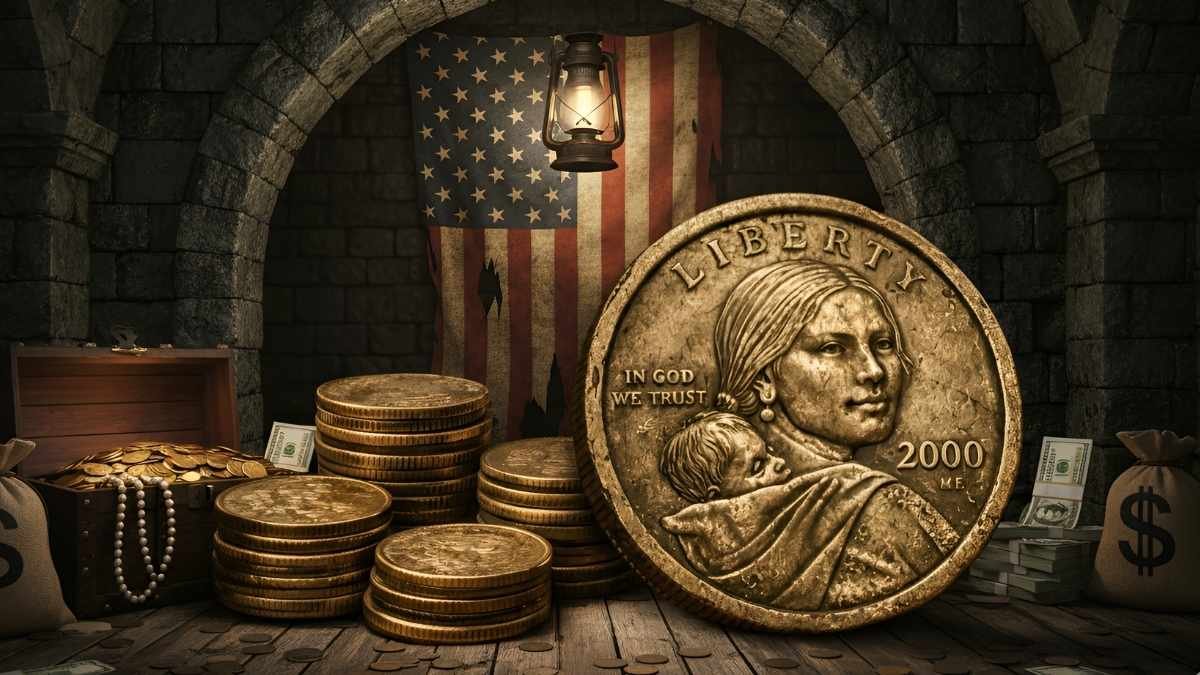
The Sacagawea dollar, introduced in 2000, was designed to bring a fresh, golden look to U.S. dollar coins while honoring the Shoshone woman who guided Lewis and Clark. Although billions were minted and most remain worth just $1 in circulated condition, a tiny fraction of extreme rarities—especially error coins and special promotional issues—have sold for extraordinary sums. In 2026, collector interest in Sacagawea dollars remains intense, fueled by registry sets, major auctions, and fascination with modern U.S. errors. The record holder, the 2000-P Cheerios Sacagawea dollar, sold for $2.1 million in a landmark auction, proving that certain rare coins can reach seven figures. This value guide explains how Sacagawea dollars achieve such dramatic prices, the rarest varieties collectors hunt in 2026, current market trends, and how everyday coins compare to true rarities.
History of the Sacagawea Dollar
The U.S. Mint released the Sacagawea dollar in 2000 with a golden manganese-brass outer layer and a reverse showing Sacagawea carrying her son. Production continued through 2008 for standard circulation, then shifted to the Native American $1 series (2009–present) with changing reverses. Most circulation strikes are common and worth face value. The coins that reach $2.1 million are extreme errors, promotional issues with documented low survival, or experimental strikes that escaped quality control.
Factors That Drive Sacagawea Dollar Prices to $2.1 Million
Extreme values come from a combination of:
- Ultra-low survival — Only a handful of examples known in high grade
- Documented rarity — Coins from limited promotions (e.g., Cheerios) with clear provenance
- Dramatic errors — Off-metal strikes, mules, or broadstrikes that create unique appearance
- Gem certification — MS-68+ or PR-69+ slabs from PCGS or NGC
- Collector competition — Registry sets and auction bidding wars
In 2026, demand for certified modern errors and key Sacagawea varieties remains very strong.
Top Rare Sacagawea Dollars & 2026 Values
The $2.1 million record belongs to the 2000-P Cheerios Sacagawea dollar—a promotional coin with enhanced tail feather detail, only 5,500 released, and fewer than 100 known today in top grades.
Current high-end values (PCGS/NGC graded, early 2026 trends):
| Variety / Issue | Rarity Level | Typical Value Range (2026) | Record High Sale |
|---|---|---|---|
| 2000-P Cheerios Enhanced Feather | Extreme (fewer than 100 known) | $50,000 – $2,100,000+ | $2,100,000 |
| 2000-P Wounded Eagle (DDR) | Very rare | $5,000 – $100,000+ | $192,000 |
| 2000-P Goodacre Presentation | Rare (5,000 made) | $2,000 – $20,000 | $29,900 |
| 2000-P Sacagawea / Washington Mule | Ultra-rare (fewer than 20 known) | $100,000 – $500,000+ | $192,000 |
| 2000-P Broadstrike | Rare broadstrike | $5,000 – $50,000+ | $50,000+ |
| 2007-D Missing Edge Lettering | Scarce | $100 – $1,500 | $2,300 |
The Cheerios variety leads because of its documented history, low survival, and dramatic visual difference from regular coins.
How Rare Sacagawea Dollars Reach $2.1 Million
The Cheerios Sacagawea hit $2.1 million because:
- Only 5,500 were distributed in Cheerios cereal boxes in 2000.
- Enhanced reverse detail (sharper tail feathers) sets it apart from regular 2000-P coins.
- Survival rate is tiny—most were spent or lost.
- High-grade (MS-68+) examples are almost nonexistent.
- Auction competition and strong provenance drive prices to record levels.
Similar dynamics apply to mules and broadstrikes—low original numbers + extreme rarity + collector frenzy = seven-figure potential.
Current Market Trends in 2026
Modern U.S. dollar errors and Sacagawea varieties stay very active in 2026. Online auctions (Heritage, GreatCollections) regularly feature six-figure sales for Cheerios and mule examples. Registry set competition pushes high-grade pieces higher, while circulated errors (missing edge lettering, minor broadstrikes) trade in the hundreds to low thousands. Demand is strong for certified coins with clear provenance and strong eye appeal.
How to Identify and Value Your Sacagawea Dollars
- Check the date (2000-P for Cheerios or Goodacre) and look for enhanced tail feathers.
- Examine the eagle for doubling or missing edge lettering.
- Weigh or check thickness for broadstrikes/off-metal strikes.
- Submit high-potential coins to PCGS or NGC for grading.
- Use auction archives (Heritage, GreatCollections) for recent comparable sales.
FAQs – Sacagawea Dollar 2026 Value Guide
- What Sacagawea dollar sold for $2.1 million? The 2000-P Cheerios enhanced feather variety, sold in a major auction.
- Are any Sacagawea dollars worth thousands in 2026? Yes—major errors (Cheerios, mules, broadstrikes) regularly reach $5,000–$100,000+ in top grade.
- How can I tell if my Sacagawea dollar is rare? Look for enhanced tail feathers, missing edge lettering, or unusual shape; get it graded by PCGS or NGC.
- What’s the most common Sacagawea dollar value? Circulated coins are worth $1 (face value); uncirculated common dates are $2–$10.
- Where should I sell a valuable Sacagawea dollar? Major auction houses (Heritage, GreatCollections) or reputable dealers; always grade high-value coins first.
Conclusion
In 2026, most Sacagawea dollars remain worth face value, but the rarest errors and promotional issues prove that modern U.S. coins can reach $2.1 million and beyond. From the Cheerios variety to mules and broadstrikes, these anomalies captivate collectors with their rarity and visual drama. Examine your collection or change carefully, submit promising pieces for grading, and follow major auctions for the latest trends. The excitement of modern coin collecting lies in exactly these unexpected treasures—keep searching!